About Luke
Attention is everything
Here's the Super Positioning back story...
I was briefly at an extremely well-funded startup I'll call The Unicorn.
Big-name specialists were brought in to work on positioning and narrative.
The work cost hundreds of thousands of dollars (!) not to mention the endless staff hours spent on implementation.
In the end, there was almost nothing to show for it.
The most alarming thing to me, however, was the lack of concrete fundamentals driving the whole process.
Did the startup need a narrative, or better competitive positioning? Did it need a new brand (whatever that meant) or should it stick with its attempt at (so-called) category creation?
In truth, we were groping around in the dark.
It's almost impossible to find a solution when you can't accurately diagnose the problem.
The result was positioning via consulting roulette, with each spin of the wheel costing six figures (and months of distraction), leaving the startup back where it started.
Frankly, I thought this was insane.
There had to be a better way.
There has to be something that could plug this massive gap in how the company thought about its positioning, especially once you've grown past the 'find a niche' stage.
So I went on my own slightly insane journey, spending three years obsessing over the solution, over why some positioning approaches worked in some contexts and not in others.
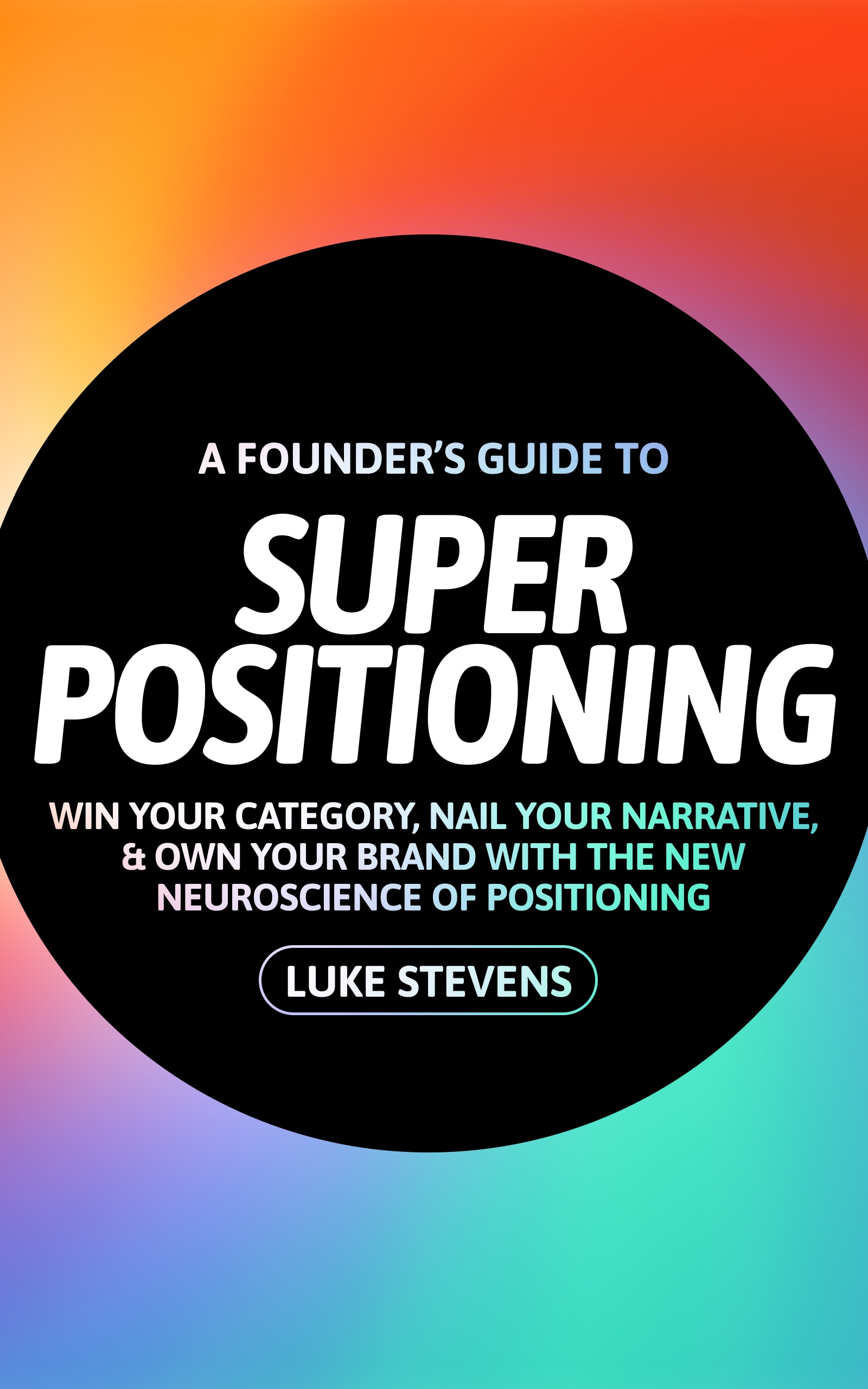
The result is Super Positioning.
And the answer hinged on one very simple idea...
The neuroscience of positioning
That idea was a new-to-B2B way of understanding attention.
Attention seems like a small thing — it's our focus; it's what we pay to things.
But attention is everything.
It's how we fundamentally exist in the world. Our entire existence is mediated through our attention.
And the more we can understand that attention — and the two hemispheres of our brains that generate it — the more strategic and deliberate we can be in how we use and engage it.
In Super Positioning, the key to understanding attention, and by extension, positioning, comes from one of the most fascinating thinkers of our time: Dr. Iain McGilchrist.
McGilchrist coined the 'hierarchy of attention' and gives us this new first-principles approach to attention, specifically the two modes of attention we use to attend to the world in two quite different ways.
It turns out those two modes of attention match the two major ways startups do positioning — big-picture narrative/category creation and narrow-focused niches and JTBD.
Add brand-as-memory from the B2C world, and we have three fundamentals prongs that explains the major approaches to positioning (and more).
The result is that now, with a stronger understanding of the mind, we can now build a stronger position in the mind.
Personally, I've found this insanely helpful. It just has so much explanatory power. For example, it's helped me understand:
This has been immensely helpful in my own client work. It has given me new first principles for:
- How to work out which positioning approach is right for you.
- How to work out your narrative structure, and how to tailor it for investors vs. customers.
- How to ensure your homepage and website accurately convey the position you're trying to build.
It's all based on the three fundamental prongs of super positioning: broad, outward attention, narrow focus attention, and memory.
They've been unbelievably helpful for me, and I hope they'll be equally helpful for you, too.
In practical terms, I hope they help you work out your change story, your differentiation story, and your memorable hook, and make you super relevant, super useful, and super memorable.
If that sounds like something you need, dive into the book, check out the audio below, or get in touch to discuss a project. (Yes, I help clients think through — and execute on — the three prongs of super positioning!)
Get in touch